
The Ontology Layer
One business.
One understanding.
Every AI, every time.
Your business is being interpreted by AI right now, by tools you chose and tools you didn’t. A sales copilot. A support chatbot. A research agent. An AI assistant an employee opened in a new tab.
Each one is forming its own understanding of who you are, what you offer, how you operate, and what’s true.
Visilayer’s Ontology gives connected AI systems one governed understanding of your organization to reason from.
Why it matters
The same question.
Three different answers.
Ask three AI tools inside the same company what your pricing policy is, who your best customers are, or what makes your flagship product or service different. You may get three different answers.
Not because the tools are bad. Because they may not be working from the same governed, structured picture of the organization. One retrieves a document. Another relies on a database. Another works from what an employee put into the prompt.
The gap is invisible until it’s expensive:
- The wrong discount approved.
- The wrong policy quoted.
- The wrong recommendation made.
- The wrong answer given to a customer.
Scroll to see the full diagram →
And deeper still
It goes further than
which tool somebody opened.
Without shared business context, every employee using AI can inadvertently give it a different version of the organization: what they remember, what they have access to, what they’ve saved, or what they personally believe is still true.
Multiply that across an organization and AI isn’t operating from one understanding of the business. It’s operating from many.
The point
Give connected AI systems one governed model of your organization, holding its meaning, relationships, rules, processes and objectives. Then they can reason from your business context instead of reconstructing it prompt by prompt.
What it is
The Ontology is your organization,
structured for AI.
An ontology is a working model of your organization. Customers. Products. Services. Locations. People. Policies. Pricing. Contracts. Transactions. Processes. But an ontology does more than name them.
- What exists.
- How things relate.
- What they mean.
- Which rules govern them.
- What actions can be taken.
- What the organization allows to happen.
Scroll to see the full diagram →
The distinction
Not a document about your organization.
A structure AI can reason with.
It defines how things relate, where the underlying information lives, which definitions are authoritative, which rules apply, and what can happen next.
- Meaning, not just data.
- Intent, not just structure.
- Actions, not just answers.
01 · Understood externally
External AI systems get you right
The structured business context that helps external AI systems accurately understand, compare, and recommend you.
AI Recommendation Readiness02 · Reasoned about internally
Internal systems share definitions
Dashboards, analytics, copilots, and decision systems work from shared definitions, relationships, rules, and context instead of reconstructing the business independently.
Decision Support03 · Ready to act autonomously
Agents act within the rules
Agents can qualify, quote, route, schedule, approve, respond, and execute workflows within the rules and permissions the organization defines.
Agent ReadinessFrom knowing to doing
Your Ontology models not only what your organization knows,
but what it can do.
A useful business model needs nouns. But an operational business needs verbs.
What things are
- A customer has an eligibility status.
- A product has a price.
- An order has approval thresholds.
What can happen next
- An order can be modified.
- A lead can be routed.
- A shipment can be scheduled.
- A discount can require approval.
- A customer can be qualified.
- A policy can prevent an action.
Why it matters
Visilayer models the entities and relationships that describe the organization alongside the rules, permissions, and actions that govern what happens next.
That is what turns business knowledge into infrastructure AI can act upon.
Why not just documents
AI can reason without your business model.
It just can’t reliably reason as your business.
Give an AI system documents, databases, prompts, and retrieval tools and it can produce remarkably useful answers. What it cannot do is infer your definitions, your rules, your permissions, and which source is authoritative when two of them disagree.
Retrieval finds text. An ontology supplies meaning, and the governance that comes with it.
Different interfaces can come and go. The business model underneath them remains.
What it unlocks
Ask your organization a question.
Get an answer grounded across where the information lives.
Your systems were never designed to share the same understanding of the organization. They don’t have to share the same data model. Visilayer gives information across those systems shared meaning, then connects that meaning to the systems where the underlying data lives.
The division of labour
- The Ontology becomes the map.
- Your systems remain the sources.
01
Connect information across systems.
02
Give AI shared business context.
03
Reason across the organization without rebuilding the data estate.
How it’s built
Visilayer doesn’t begin
with a blank model.
Enterprise ontology projects can require significant modeling, integration, and implementation. Visilayer was designed around a different assumption:
- Most organizations don’t have months to spend defining what their industry already knows.
Our Ontology framework starts with the operating patterns, concepts, relationships, and decision structures common to your industry, then adapts them to what is specific to your organization.
Healthcare doesn’t operate like hospitality. Hospitality doesn’t operate like professional services. A franchise doesn’t operate like a school.
The premise
Your organization may be unique.
Its underlying business patterns aren’t.
That means less time defining what your industry already knows, and more time modeling what makes your organization different.
Built for the mid-market
Enterprise AI infrastructure shouldn’t require
an enterprise transformation.
The most sophisticated AI infrastructure has largely been built for the world’s largest organizations.
Visilayer brings the same fundamental idea to companies that want sophisticated AI infrastructure without thousands of engineers, years of transformation, or an enterprise-scale technology program.
You don’t rebuild your organization around Visilayer. We build around the organization you already run.
- Your existing systems can remain where they are.
- Your data doesn’t have to live in one place.
- Your organization doesn’t have to become a software company.
What we build
We build the semantic infrastructure between the business you already run and the AI you want to use.
Your business, modeled as a system
Give AI a shared understanding
of how your organization works.
Your systems hold pieces of the business. Visilayer models the objects, properties, rules, and actions that give those pieces meaning.
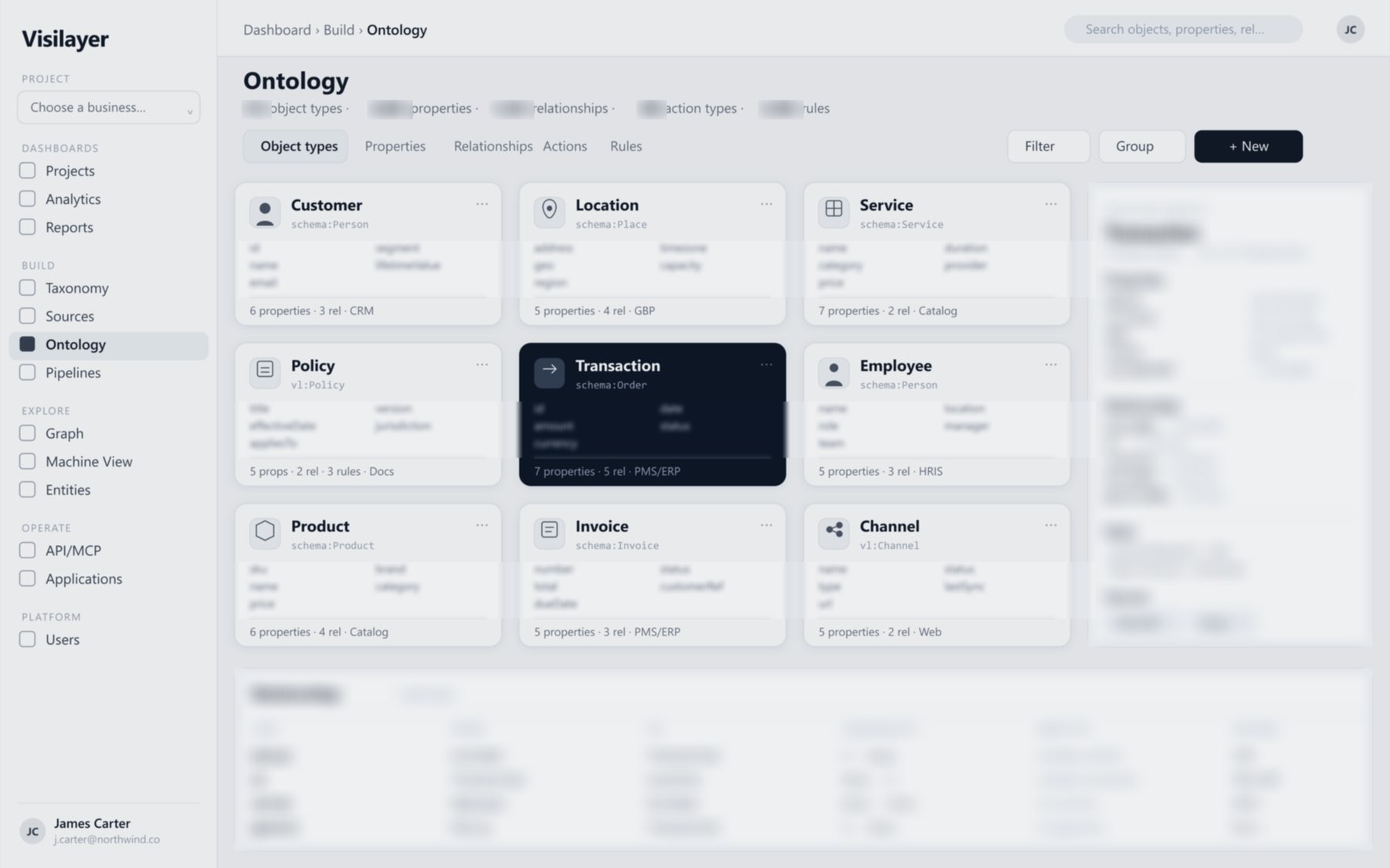
Your business becomes a machine-readable model, not another pile of disconnected data.
Connect the meaning
Relationships turn scattered data
into business context.
A customer, transaction, location, policy, employee, and product may live in different systems. Visilayer defines how they relate, what those relationships mean, and which rules govern them.
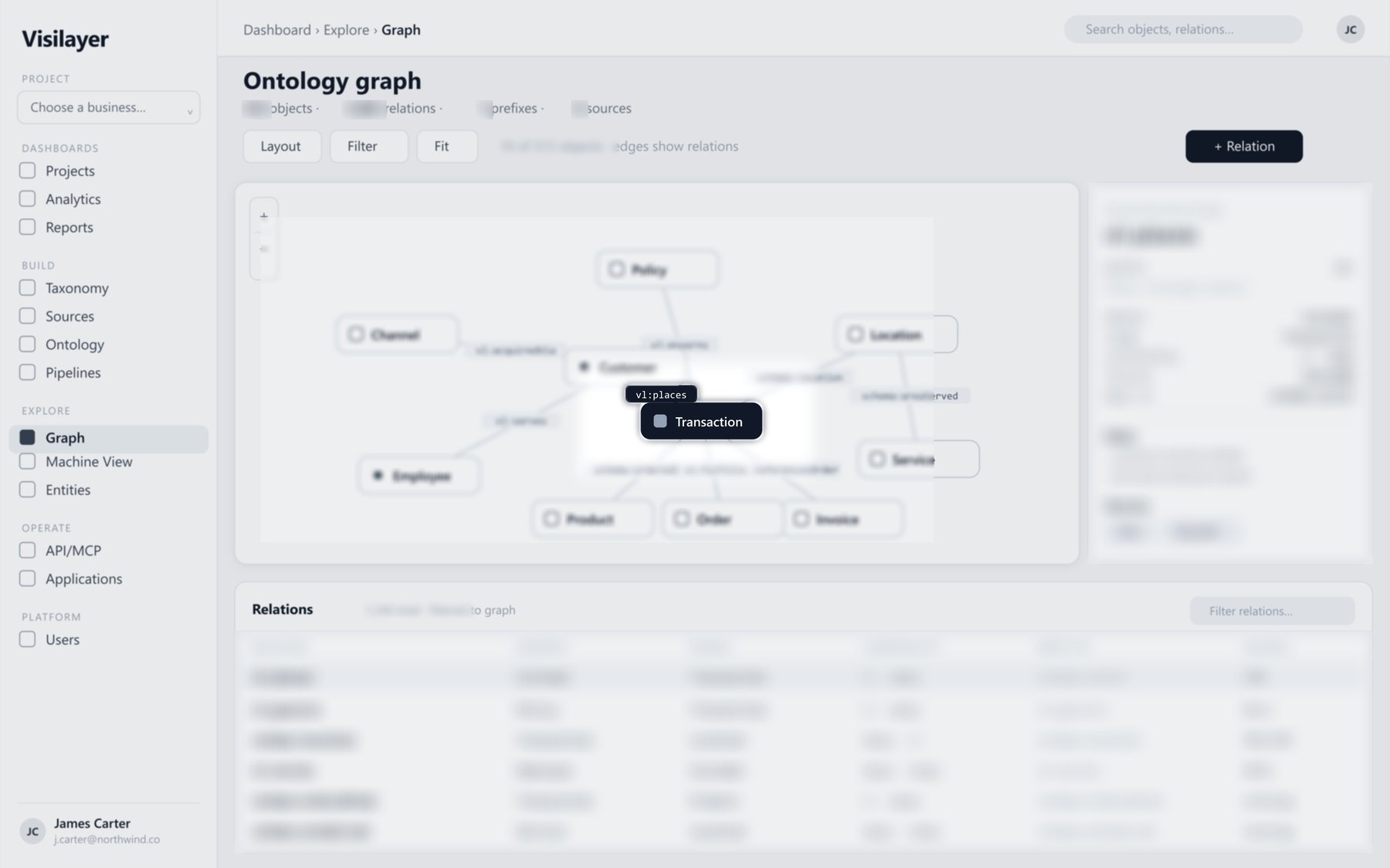
Different systems. One semantic understanding of the business.
Built to be used
The Ontology isn’t the destination.
It’s the shared business understanding behind your AI.
Your teams do not need another place to search for answers or another application to learn.
Visilayer makes the organization’s business meaning available to the systems that need it. AI assistants, agents, applications, decision-support tools, and workflows. Through APIs and MCP, those systems can work from the same understanding of your objects, relationships, rules, actions, and business context.
Your AI can change. Your applications can change. Your underlying business meaning remains reusable.
Scroll to see the full diagram →
Governed by design
One understanding does not mean
everyone sees everything.
A useful enterprise ontology cannot simply make information accessible. It must make the right information accessible to the right human or AI system under the right conditions.
What the structure carries
- Definitions have owners.
- Sources have authority.
And what it constrains
- Sensitive information has boundaries.
- Agents operate within defined constraints.
The distinction
Governance is not something added after AI starts using the Ontology. It is part of the structure AI reasons from.
Because an AI system knowing what it can do is not enough. It also needs to know what it may do.
The partnership
An asset that gets more valuable
as your organization changes.
New products launch. Policies change. Systems get replaced. Teams reorganize. New AI tools arrive.
The Ontology is designed to evolve with them.
New concepts, relationships, rules, sources, and actions extend the existing business model rather than requiring every AI application to relearn the organization independently.
Visilayer remains the ontology partner beyond the initial build, helping extend and govern the model as the organization changes. Definitions remain owned. Changes remain traceable. Connected AI systems continue working from the current, approved representation of the organization.
The goal
The goal is not simply a source of truth. It is a governed source of business meaning.
Works where you work
Any model. Any agent.
Your choice.
A private LLM behind your firewall. A commercial model your teams already use. A department-specific copilot. An autonomous agent. A future system that hasn’t been selected yet.
Visilayer does not require your organization to bet its AI strategy on one model vendor.
- The model can change.
- The interface can change.
- The agent can change.
What your organization knows to be true about itself doesn’t have to.
The Ontology is the constant underneath the connected systems. Models and agents can access the business context, data, rules, and permitted actions they need through governed interfaces and integrations. As models improve, the structured business context underneath them becomes more useful, not less.
Scroll to see the full diagram →
The direction
Better models do not eliminate the need for business context. They become better at using it.
What changes
Before and after
the Ontology.
Same question. Same tools. One governed model between them.
Scroll to see the full diagram →
The bigger picture
One semantic foundation.
Three AI outcomes.
The applications are different. The infrastructure underneath them is the same.
Scroll to see the full diagram →

What’s next
See what your organization
looks like as an Ontology.
Before anything is connected, we’ll show you the shape of it, and the gaps preventing your current AI systems from working from one shared understanding.
Get started
Give every AI
the same understanding of your business.
We’ll show you how your organization can be modeled, starting from your industry’s foundation rather than a blank page.
Show me my Ontology- The concepts that define your organization.
- The relationships connecting them.
- The systems where the underlying information lives.
- The rules that govern decisions.
- The actions AI can be permitted to take.
- The gaps preventing one shared understanding today.